About the Blog:
In a time of uncertainty and conflict, finding moments of clarity can feel rare. This is why we share our own Abhishek Patane’s reflections from his recent trek through one of the planet’s most fascinating yet fragile ecosystems: the Himalayas. In this blog, Abhishek shares his personal reflections on resilience, responsibility, and the delicate balance that sustains life, even in the most turbulent times.
About the Author:
Abhishek Patane is Olive Gaea’s Regional Growth Leader. With nine years of experience in sustainable finance, development, and public policy, he has led global research projects and designed programs supporting vulnerable communities across India. At Olive Gaea, he helps organisations accelerate their sustainability journeys using AI-driven solutions, turning insight into tangible, real-world impact.
A few weeks ago, I found myself standing on a ridge at Kuari Pass in the Nanda Devi Biosphere Reserve in Uttarakhand, India, looking out across a vast Himalayan horizon. Peaks like Dronagiri and Kamet, among many others, rose sharply above the landscape, their slopes catching the shifting light and the soft alpine glow of morning and evening.
It was one of those moments when the mountains make you pause.
But as beautiful as the view was, something felt different. Locals along the trail told us that snowfall here used to begin as early as November. This year, however, the snow arrived only toward the end of January, reportedly the latest start in nearly four decades.
Standing there, it was hard not to think about how the Himalayas – often called the “water towers of Asia” – are quietly changing.
While much of my work has revolved around questions of water systems, sustainability, and climate resilience, seeing these shifts firsthand offered a very different perspective.
And it made the realities of climate change feel far less abstract.
When the Snow Arrives Late
A couple of conversations with a local guide and a few villagers stayed with me throughout the trek.
They all pointed toward the surrounding peaks and told us that snowfall in the region used to begin as early as November. This year, however, snow arrived only toward the end of January – reportedly the latest start in nearly four decades.
Looking across the horizon at peaks like Dronagiri and Kamet, we could see exposed rock faces where locals say snow once blanketed the mountains through winter.
These observations echo a broader scientific reality.
Across the Hindu Kush – Himalaya region, nearly 55,000 glaciers form the largest freshwater reserve outside the polar regions. These glaciers feed river systems that sustain the water security of around two billion people across Asia.
Reports such as the World Bank’s Glaciers of the Himalayas: Climate Change, Black Carbon, and Regional Resilience highlight how rising temperatures, combined with pollutants such as black carbon, are accelerating glacier retreat across the Himalayan region. Black carbon particles deposited on snow and ice reduce reflectivity and increase heat absorption, accelerating melting, besides other factors inducing temperature rise and consequent glacier melting.
These changes are altering snowfall patterns and reshaping the timing and volume of water flows in major river systems.
The impacts extend far beyond the mountains:
- Increased flood risks in the short term due to rapid glacial melt
- Long-term water stress as glaciers shrink
- Disruptions to agriculture and hydropower systems
- Increased vulnerability for mountain communities and downstream populations
In other words, what happens in the mountains affects millions far beyond them.
Springs: The Lifeline of Mountain Communities
My academic training at the Tata Institute of Social Sciences, where I pursued a Master’s in Water Policy and Governance, and subsequent work in the sustainable development sector focused extensively on watershed and springshed management.
Walking through Himalayan villages during the trek reminded me just how central springs are to mountain life.
Simple stone springs where water flowed steadily into a basin are quite visible as you pass the villages. It looks modest, but systems like these sustain entire communities.
According to NITI Aayog, India has around five million springs, nearly three million of which are located in the Himalayan region. Nearly 200 million people depend on spring water across mountain regions such as the Himalayas, Western Ghats, Eastern Ghats, and Aravallis.
Yet many of these systems are under stress.
Evidence suggests that nearly half of the perennial springs in the Indian Himalayan region have either dried up or become seasonal, leaving thousands of villages increasingly vulnerable to water shortages.
Springs function as natural groundwater discharge systems, sustained through complex interactions between rainfall, snowmelt, forests, soils, and aquifers.
When climate patterns shift, whether through changes in precipitation, glacier melt, or land use, this delicate hydrological balance is disrupted.
In many ways, water is the first place where the impacts of climate change become visible.
Forests: Silent Guardians of the Water Cycle
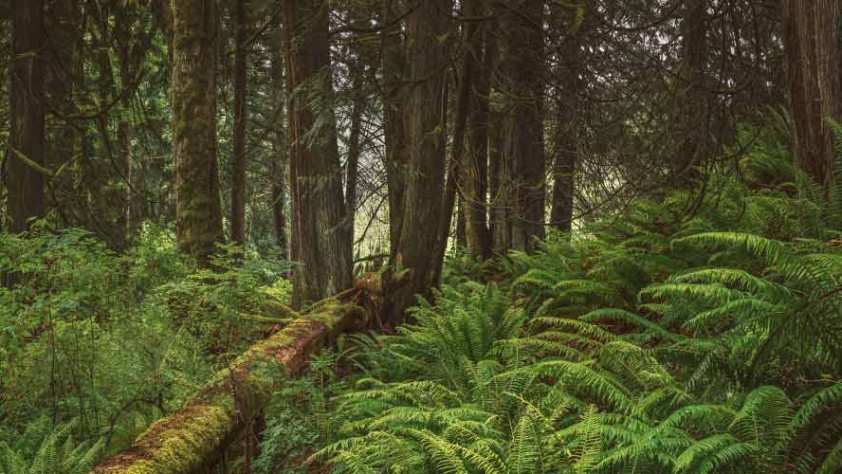
Much of the trail winds through dense forests of golden oak, rhododendron, and cedar.
At one point along the trail, I paused beside an enormous golden oak tree and sat quietly there for a while, my hand resting on its bark, almost as if breathing with the tree and absorbing the quiet rhythm of the forest around me. Trees like these are remarkable givers – quietly storing carbon, anchoring soil, regulating water, and sustaining entire mountain ecosystems.
Not far from this trail lies Reni village, the birthplace of the Chipko movement, where villagers, led by women such as Gaura Devi, famously embraced trees to prevent them from being cut down. Sitting beside that oak tree, it was hard not to think about that legacy and the deep relationship mountain communities have long shared with their forests.
These forests are far more than scenic landscapes.
They are critical components of the Himalayan water system and play an important role in buffering the impacts of climate change. Forest ecosystems help:
- sequester carbon, helping mitigate climate change
- regulate groundwater recharge
- stabilize fragile mountain slopes
- sustain springs and streams
- protect biodiversity and soil health
In effect, these forests function as natural climate and water regulators.
Protecting them is therefore essential not only for conserving biodiversity, but also for strengthening climate resilience and safeguarding long-term water security across the river basins that originate in the Himalayas.
Strengthening Climate Adaptation in Mountain Regions
As climate change pressures intensify, both mitigation and adaptation efforts must accelerate.
Globally, and particularly across Asia, governments and development institutions are increasingly focusing on strengthening resilience in high-mountain regions.
Recently, the Asian Development Bank issued a $100 million green bond aimed at raising awareness about glacier melt and supporting climate resilience initiatives across Asia. These efforts support projects focused on water resource management, disaster risk reduction, climate-resilient infrastructure, and sustainable livelihoods in mountain regions.
But adaptation is not only about large infrastructure investments.
It also involves ecosystem restoration and community-driven approaches, such as watershed and springshed management.
Across the Himalayan region, there is growing recognition of the importance of springshed management, which integrates hydrogeology, local knowledge, and community governance to restore and recharge springs that sustain mountain communities.
Such nature-based approaches, rooted in both science and traditional knowledge, will be essential for strengthening resilience in fragile mountain ecosystems.
Listening to the Mountains
The trek offered breathtaking landscapes – towering peaks, silent forests, and expansive Himalayan horizons.
Standing on the ridge at Kuari Pass, looking out across the sweeping skyline of the Himalayas, the view felt both timeless and humbling. Peaks stretched endlessly across the horizon, reminding me that these mountains are not only magnificent landscapes, but living systems that sustain rivers, ecosystems, and communities far beyond them.
But more importantly, the journey offered perspective.
Working across water governance, sustainability policy, development and finance, and climate management, the experience reinforced a powerful truth: the environmental systems we study and manage are deeply interconnected and increasingly vulnerable.
Glaciers, springs, forests, and mountain communities form a delicate balance.
Climate change often feels abstract when discussed in policy reports or sustainability frameworks. But in the Himalayas, it becomes tangible — visible in retreating snowlines, changing snowfall patterns, and stressed water systems.
The mountains are sending signals.
The question is whether we can listen and respond fast enough.